
 Close
Close  Menu
Menu 
作者: Robbins
Cooperative Innovation at the Manhattan Tunnel Project: Digger Shields with Expandable Segments to Excavate Complex Fill
In what is billed as the most urgent infrastructure project in the U.S., the Hudson Tunnel Project is a critical piece of infrastructure to build two new passenger rail tracks between New York and New Jersey and rehabilitate the century-old North River Tunnel, which was badly damaged during Superstorm Sandy. In this paper, the authors will examine the cooperative structure that allowed the generation of a singular solution for the Manhattan tunnels, and the design of the digger shield machines and segments that are unique to the complexities of this urban infrastructure project.
Robbins celebrates TBM acceptance for Ellicott City North Tunnel
Robbins marked a major project milestone in Q4 2025 with the substantial completion of the factory acceptance test (FAT) for a refurbished Main Beam TBM at its Solon, Ohio manufacturing facility. The veteran machine, rebuilt in partnership with contractor Kiewit, is set to excavate the 1.5 km (0.9 mi) long Ellicott City North Tunnel, a critical flood mitigation project in Howard County, Maryland, USA.
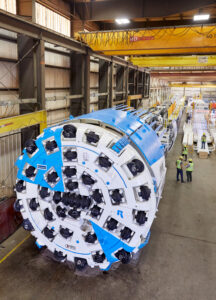
The Robbins Main Beam TBM will bore through a mix of granitic rock beneath Ellicott City, minimizing surface disruption in the densely built, heritage-rich area.
The 5.6 m (18.4 ft) diameter TBM, originally manufactured by Robbins in 1991, has a distinguished global track record. The machine has successfully excavated multiple tunnels totaling more than 18 km (11 mi) and is now entering its next chapter as part of Maryland’s largest stormwater infrastructure project to date.
“Robbins and Kiewit share a long-standing partnership focused on quality TBM rebuilds and performance,” said Doug Harding, Robbins Vice President. “We are marking not only the acceptance of the machine, but also a continued commitment to delivering durable tunneling solutions that meet the evolving demands of major infrastructure projects.”
The Ellicott City North Tunnel is a centerpiece of Howard County’s Ellicott City Safe and Sound plan. Designed to divert stormwater runoff away from the historic downtown area—an area hit by multiple catastrophic floods in recent years—the tunnel will convey up to 26,000 gallons (98,000 liters) of water per second during major storm events. The TBM will bore through a mix of granitic rock beneath Ellicott City, minimizing surface disruption in the densely built, heritage-rich area.
“Excellent Engineers, Craft and Managers of Robbins and Kiewit have worked together at Robbins’ plant in Solon on a daily basis over the last year to achieve this milestone of substantial completion of the FAT. Synergy efforts were required and well delivered to get the TBM to increased technical and safety standards,” said Christof Metzger, Area Manager for Kiewit.
The TBM is expected to begin tunneling in 2026 following TBM assembly and launch shaft construction in Maryland. Its performance will be supported by Robbins’ field service team to ensure smooth operations throughout the project’s duration.
Huge Robbins Slurry TBM breaks through in Hiroshima
A hard rock heavyweight crossed the finish line this spring with the successful breakthrough of a Robbins 13.67 m (44.8 ft) Slurry TBM in Hiroshima, Japan. The completion of the 1.4 km (0.9 mi) section of the Hiroshima Expressway Line 5 on April 30 is a landmark achievement in challenging geology, and marks the first time a foreign-made large-diameter Slurry TBM has been used to excavate hard rock in the country.
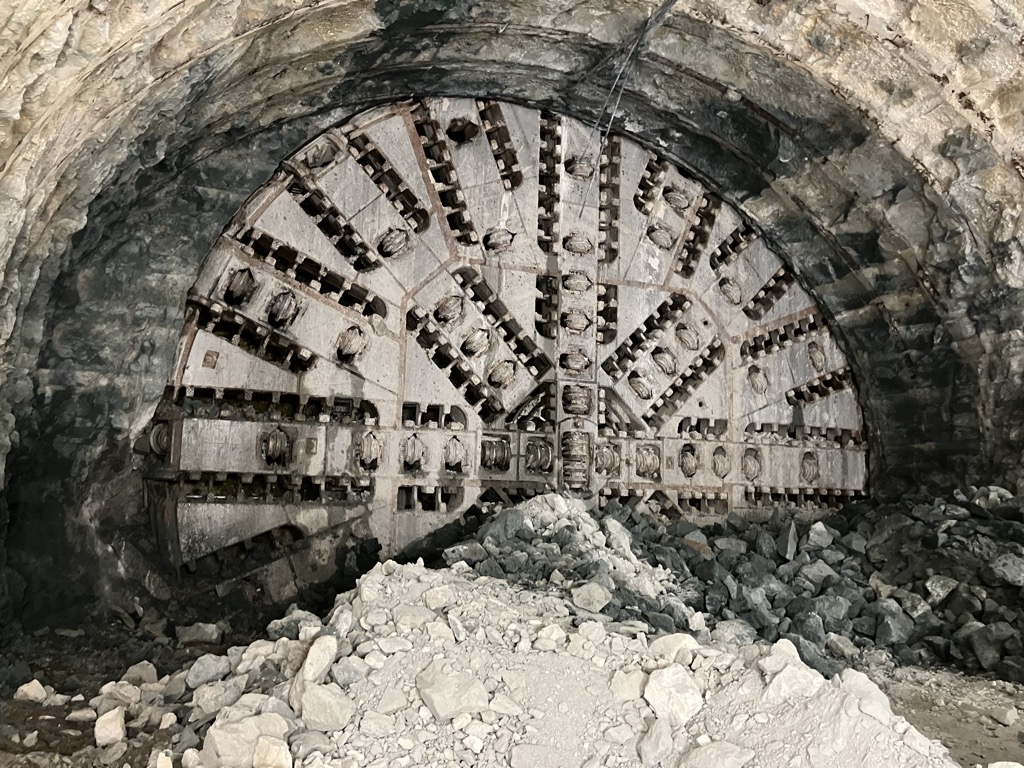
The 13.67 m (44.87 ft) diameter Robbins Slurry machine broke through this spring, marking the completion of an excavation through challenging granitic rock at high water pressures.
The 2,400 metric ton (2,650 US ton) Robbins TBM was deployed to excavate beneath Hiroshima’s dense urban landscape for the Obayashi-Taisei-Kosei joint venture. The tunnel connects the city’s urban center with a major national highway network and improves access to Hiroshima Airport.
“While there is little track record of large-diameter hard rock drilling with TBMs in Japan, Robbins’ know-how and on-site support for disc cutters, which have a long track record in hard rock drilling, were excellent. We have been able to obtain great results and technical knowledge for future large-diameter slurry hard rock drilling work,” said Mr. Tetsuya Taniguchi, Deputy Director of Obayashi.
The TBM was specially designed to handle the region’s challenging geology, including granite formations with unconfined compressive strengths (UCS) of up to 130 MPa (19,000 psi). The cutterhead and other components were built to withstand these abrasive rock conditions as well as high water pressure.
The machine’s journey began long before its initial cut. Due to the confined urban site and tight transportation restrictions, the TBM was assembled in sections, with each section being split into manageable weights and sizes. Once at the jobsite, which was only 30 meters (100 feet) wide by 60 meters (200 feet) long, the TBM was reassembled using Onsite First Time Assembly (OFTA)—a process that enabled the team to meet a strict timeline of eight months for machine assembly.
The geology encountered was generally very massive, hard granite—while some fracture zones were expected to appear, crews conducted horizontal boring in front of the face every 50 m (160 ft) and these fracture zones were not found. “In addition, there was a section of low cover directly beneath a residential area, but we were able to pass through it safely by taking the appropriate measures to mitigate environmental impacts such as vibration, noise and ground surface displacement,” said Mr. Taniguchi.
As the team moves closer to bringing the tunnel online, the success of the project proves the effectiveness of Slurry TBMs in challenging hard rock conditions. The completion of the tunnel for the project owner, Hiroshima Expressway Public Corporation, is also a boon to the region, supporting its growing economy and tourist sector.
“From the complex machine launch to breakthrough, we are proud of this tunnel being completed for the city of Hiroshima and congratulate the Obayashi-Taisei-Kosei JV. It will make a huge positive impact for the city,” said Mr. Shinichi Konda, Robbins Chief Engineer.
Robbins TBMs break through at Delhi Metro DC-07 Project
Robbins proudly announces the successful breakthrough of two 6.65 m diameter Earth Pressure Balance (EPB) TBMs on India’s Delhi Metro Phase IV DC‑07 package, achieving a seamless drive from Airforce Station to Tughlakabad Railway Colony Station via Maa Anandmayee Marg Station.
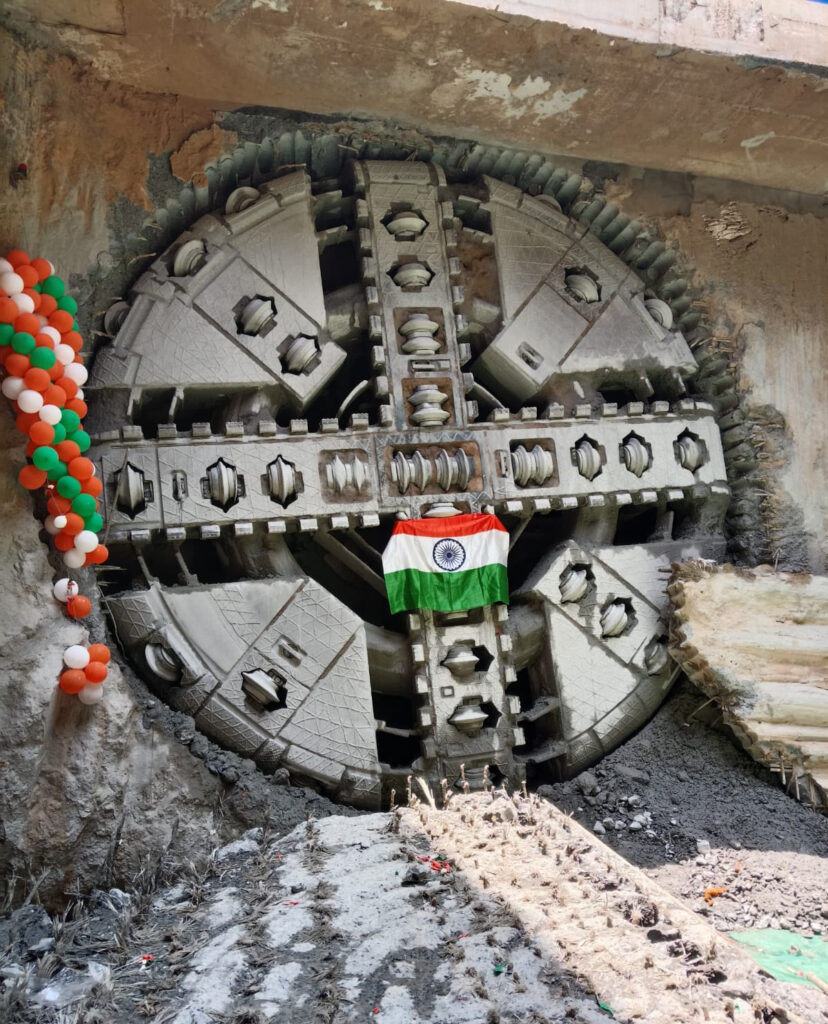
The Robbins TBMs broke through at Tughlakabad Railway Colony station, marking the successful completion of the DC07 contract for Delhi Metro.
This milestone reinforces Robbins’ commitment to delivering high-performance TBM solutions for critical urban transit projects across India. “This breakthrough is not just a milestone in tunneling, but a testament to the robustness of Robbins technology and the strong collaboration between our field teams and Afcons. The performance of the PLC systems throughout the DC-07 drives was exceptional, ensuring real-time control and precision even in highly variable ground conditions,” said Laxman Khatri, PLC Expert, Robbins India.
The twin TBM drives totaled 2,469 rings, spanning a combined 3,456.6 m of tunnel. Drive 1 totaled 2,651.6 m between Airforce Station and Maa Anandmayee Marg, while Drive 2 totaled 791 m between Maa Anandmayee Marg and Tughlakabad Railway Colony.
The recent breakthroughs in early June 2025 mark the completion of Robbins’ tunneling scope under the DC‑07 package. The drives successfully passed through densely populated urban sectors with difficult logistics and challenging mixed-ground geology consisting of rock with gravel, sand, silt and clay—all with minimal surface impact.
“From launch to breakthrough, our focus was on delivering precision tunneling with minimal surface disruption and maximum efficiency. Despite complex logistics and mixed ground conditions, both drives were completed on schedule with excellent performance. This success reflects the strength of Robbins machines and the dedication of our field teams,” said Gaurav Singh Bisht, Field Service Manager, Robbins India.
This accomplishment marks another successful chapter in Robbins’ long-standing partnership with owner Delhi Metro Rail Corporation (DMRC) and contractor Afcons Infrastructure Limited, contributing to the transformation of Delhi’s urban mobility infrastructure.
With the tunneling phase for DC-07 now completed, Robbins will continue to assist Afcons Infrastructure Limited during TBM dismantling and removal from the tunnels.
NAT 2026
Event Name: North American Tunneling Conference (NAT)
Dates: June 15-18, 2026
Location: Anaheim, California, USA
Venue: Anaheim Marriott
Booth: 123
Come join us in Anaheim, California June 15-18 at the North American Tunneling Conference, the premier tunneling event focusing on current projects, challenges, and successes in tunneling. Stop by our booth 123 to learn more about our ongoing and successful tunneling projects, and be sure to check out our insightful technical presentation.
Technical Presentation
Thursday June 18
Tunnel Boring Machines II
Platinum Ballroom 9-10
10:00 AM – 10:20 AM
Rebuild of a Veteran TBM for Maryland’s Ellicott City North Tunnel: Long-Running Partnership Enables Efficient Refurbishment of 34-year-old Main Beam
Presented by Doug Harding, Vice President, Robbins
World Tunnel Congress 2025
Event Name: ITA-AITES World Tunnel Congress
Dates: May 9-15, 2025
Location: Stockholm, Sweden
Venue: Stockholmsmässan
Stand: B04:10
Come join us May 9-15 in Stockholm, Sweden for the ITA-AITES World Tunnel Congress, the premiere event for tunneling and underground construction. More than 2,000 professionals are set to take part in the world’s top-attended tunneling conference, where hundreds of technical papers will be presented on the latest topics of interest. Stop by our stand B04:10 to converse with our expert international team, and find out the latest about our products and projects.
Use of a Tunnel Boring Machine on Nepal’s First and Second TBM-Driven Tunnels
Nepal’s mountainous terrain has historically been a challenge to tunnel through. That very terrain also holds great promise for hydropower – a resource that the country is now beginning to tap into. Launched in October 2022, a 6.4 m Double Shield TBM is making Nepal’s hydropower plans into a reality as it bores the 13.1 km headrace tunnel for the Sunkoshi Marin Diversion Multipurpose Project (SMDMP). The tunnel is connected to a 28.6 MW surface powerhouse on the Marin River.
The SMDMP is the machine’s second tunnel: on its 12.2km first tunnel (the Bheri Babai Diversion Multipurpose Project/BBDMP), the TBM finished nearly one year early and achieved 1,202 m advance in one month. It was the first instance of TBM use in the country.
In this paper, we examine the successes and lessons learned in Nepal’s mountainous conditions during excavation of both the SMDMP and BBDMP.
Robbins Double Shield Sets Record in Nepal
In the southern Himalayan mountains of Nepal, a Robbins Double Shield TBM has crossed into new territory. At the end of June 2023, the machine turned in an impressive advance rate of 1,224.13 m in one month – a record for Himalayan geology and believed to be a TBM record within the Indian Subcontinent. Launched in October 2022, the 6.4 m diameter machine has been boring the 13.3 km headrace tunnel for the Sunkoshi Marin Diversion Multipurpose Project (SMDMP).
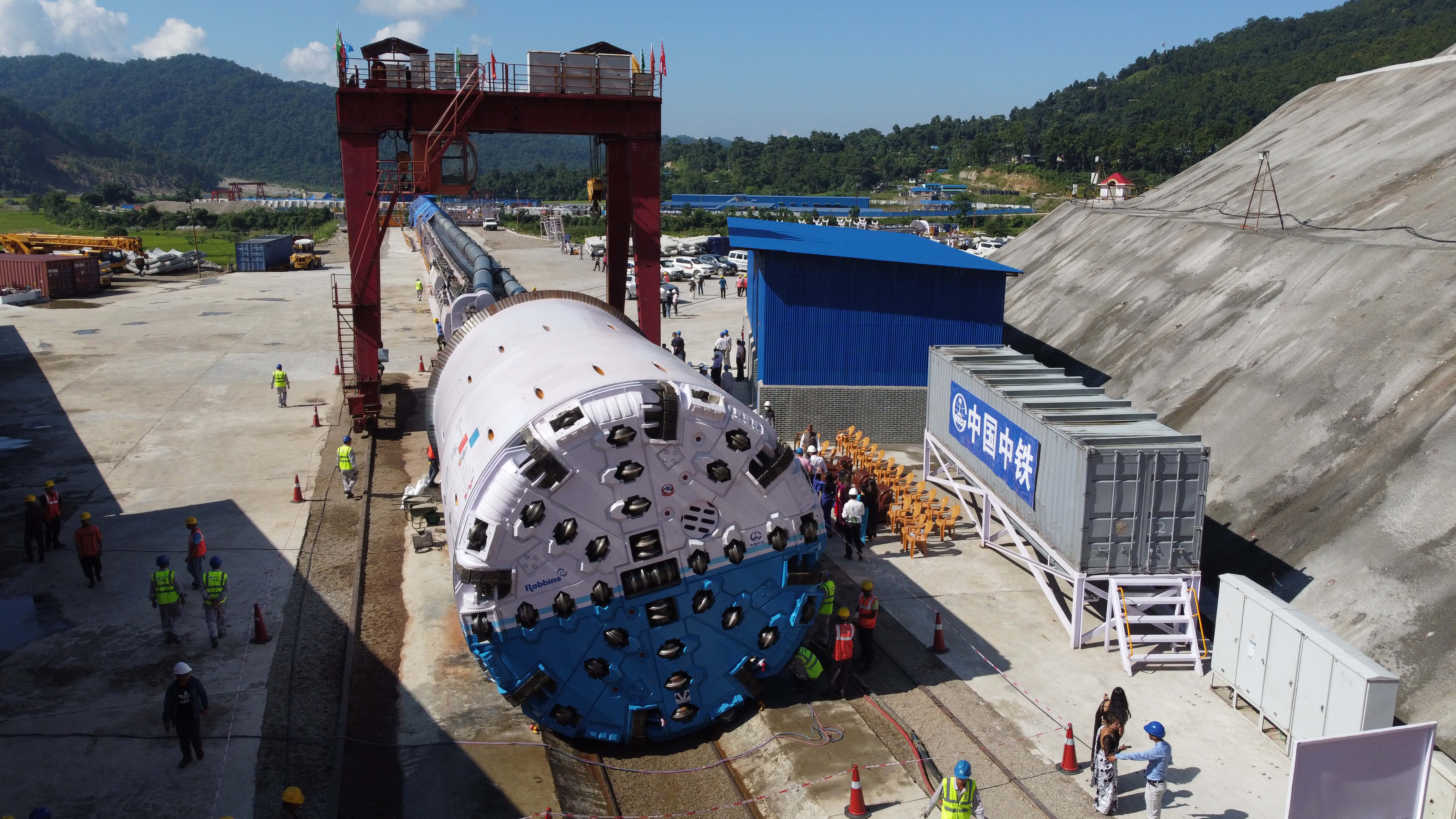
At the end of June 2023, a 6.4 m diameter Robbins Double Shield TBM achieved an impressive advance rate of 1,224.13 m in one month.
Multiple factors played into the successful result. “Proper TBM selection for the existing subsurface is the key reason for success. The Double Shield is the most logical TBM type and has played a major role in this successful journey. Operation, maintenance, and an experienced, dedicated team are additional factors,” said Mitra Baral, Project Director of SMDMP under the Department of Water Resources and Irrigation, part of Nepal’s Ministry of Energy, Water Resources & Irrigation.
Contractor Covec/B-2 echoed those sentiments: “The designed adaptation of the TBM & backup provided by Robbins is verified to be scientific and good under the geology, which are Siwalik stratum and the lower Himalayan zone–both quite complex and variable. The performance of the equipment is generally stable,” said Covec/B-2’s Project Manager, Mr. Liu Feng Fan.
Contractor B-2/COVEC (China Overseas Engineering Group Co. Ltd and China Railway No. 2 Engineering Group Co Ltd) have navigated the Robbins TBM through two major fault zones with challenging and varied conditions ranging from highly jointed mudstone, sandstone and conglomerate to quartzite, granite, and more.
The record result is all the more impressive considering the adversity the machine has overcome to date. Approximately 2,156 m into the excavation the machine became stuck in jointed sedimentary rock, requiring nine days of intensive work and a bypass tunnel to free it. As the machine progressed to more than 4 km in, the geology changed to dolomite, slate, schist, quartzite and phyllite. The machine became stuck a second time 4,669 m in due to collapsing and squeezing ground, requiring a further 27 days of work to release it.
Despite the challenges early on, the machine and its experienced crew have persevered. Currently the TBM is more than 8.3 km into the tunnel and boring in high strength granite, having passed through the two major fault zones predicted on the tunnel alignment. “Timely support from Robbins has made for a good relationship and teamwork. It has been quite important for the success of our project,” said Mr. Liu.
Prajwal Man Shrestha, General Manager of Robbins Nepal, emphasized that the successful results thus far are a milestone for the use of TBM tunneling in the country: “There are now private sector hydropower developers considering the use of a TBM for their project instead of the conventional D&B method. Very soon we may see that most tunnels longer than 6 or 7 km will be exploring the possibility of using TBMs on their project.”
As for the future of tunneling in Nepal, Mr. Baral is positive it will continue to grow and evolve: “Many TBM projects could be planned for many different areas. Taking into consideration that Nepal is a mountainous country with complex geology, tunnels are indispensable not only for irrigation and hydropower but also roads, railways, water supply, and even metro lines in the cities.”
Final Breakthrough at Bahçe-Nurdaği Railway
In June 2023, a resilient 8.0 m diameter Robbins Single Shield TBM completed its second tunnel at Turkey’s Bahçe-Nurdaği Railway. The machine completed 9.6 km of tunneling, adding on to the 9.2 km it completed in its initial railway tunnel in 2020 – for a total of more than 18 km bored.
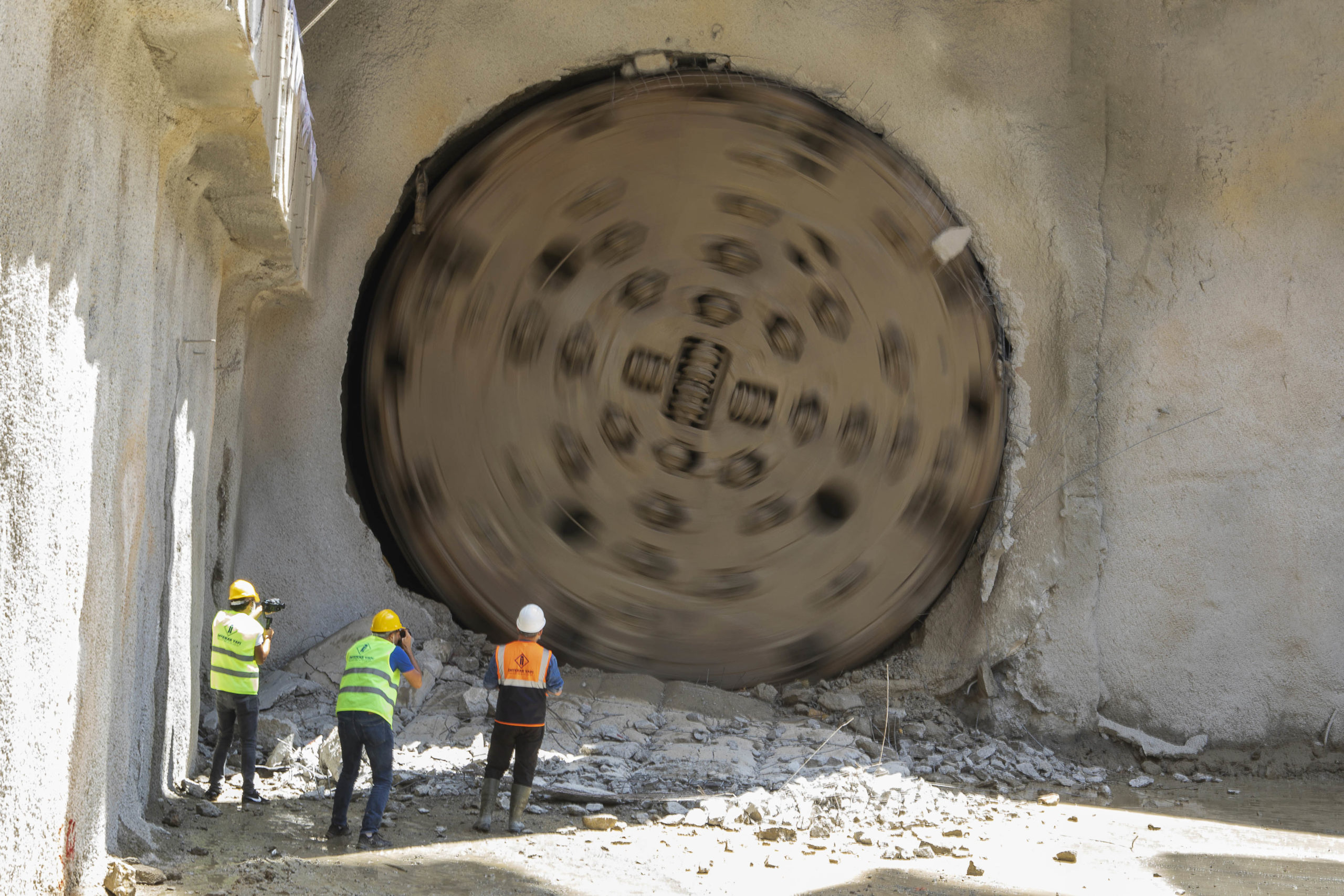
The Robbins TBM completed 9.6 km of tunneling, adding on to the 9.2 km it completed in its initial railway tunnel in 2020 (pictured) – for a total of more than 18 km bored.
“We are very proud to complete this tunnel in difficult rock formations with our excellent team by utilizing an extremely powerful and strong Robbins Single Shield TBM,” said Deniz Şahin, TBM Chief for contractor İntekar Yapı Turizm Elektrik İnşaat San. ve Tic. Ltd. Şti.
Geology in the second tunnel was comparable to the first, including incredibly hard and abrasive metasandstone with quartz, with an average of 220 MPa (31,900 psi) UCS and a Cerchar abrasion value of 3.87. The rock has some of the most extreme hardness and abrasiveness ever measured in Turkey.
After its first bore in the difficult ground, the machine required some inspection and repairs. “Robbins Field Service was always available when we requested,” said Şahin. “The biggest repairs we undertook with Robbins Field Service technicians were the main bearing seal change and checking and repairing of the TBM before launching it on the twin tunnel after the completion of the first tunnel. Both operations were completed in a short time due to good planning with Robbins technicians.”
The machine began its second bore in February 2021, achieving a best monthly advance rate of 411 m. “During tunneling we performed a normal maintenance program as given in the TBM manual, and the machine had minimum downtime, which shows the durability of Robbins TBM in very hard and abrasive rock,” said Şahin.
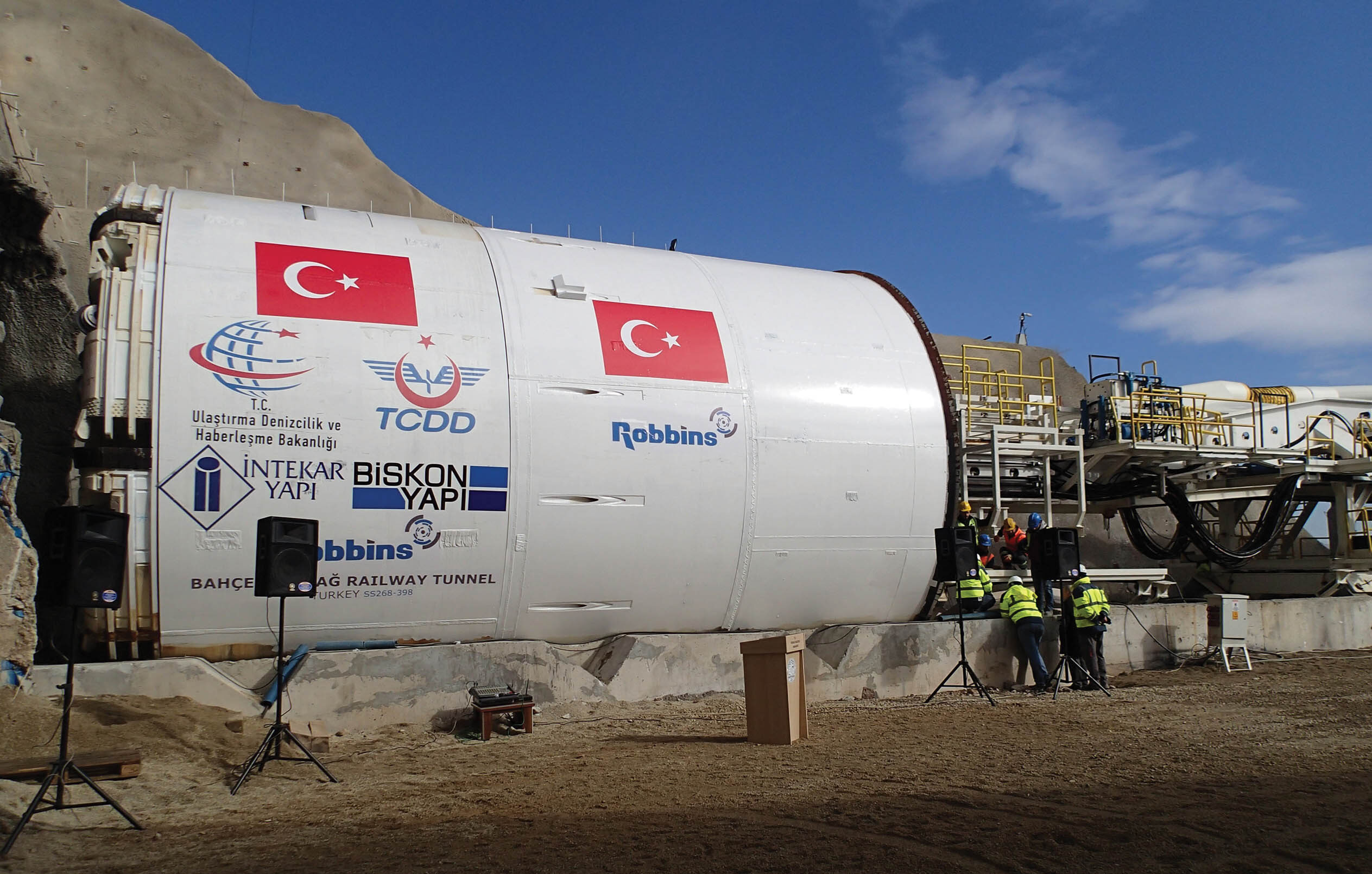
The Robbins Single Shield TBM was designed to bore in incredibly hard and abrasive geology including metasandstone with quartz – some of the hardest rock ever encountered by a TBM in Turkey.
“The Robbins TBM has performed extremely well in this project with minimal downtime and good advance rates to complete the longest twin tube railway tunnels in Turkey,” said Yunus Alpagut, Robbins representative in Turkey.
The twin rail tunnels, for owner Turkish State Railways Directorate (TCDD), will provide an economic boost to a region recovering from two consecutively devastating earthquakes with magnitudes of 7.8 and 7.6 that occurred in February 2023. The project site is located very close to the intersection of two large active fault zones, the East Anatolian Fault (EAF) and Dead Sea Fault (DSF). The tunnels were inspected after the event and were found to have sustained only minor cracking in a few segments. The new rail line will provide service between the towns of Bahçe and Nurdağı, and is part of the TCDD’s plan to overhaul the railway connection in southeastern Turkey by providing a shorter, faster route in one of the country’s busiest railway corridors.
Record-Setting Large Diameter Mixed Ground Tunneling in Turkey: The Eşme-Salihli Railway Tunnel
Large diameter tunneling has historically been seen as a challenge. Add into the equation mixed ground conditions, and it becomes a task that may seem insurmountable. How-ever, a recently completed tunnel in Turkey is a flagbearer for changing the mindset towards these challenging tunneling scenarios that are becoming more frequent. A 13.77 m diameter mixed ground Rock/EPB TBM bored the Eşme-Salihli Railway Tunnel at rates of up to 721.8 m in one month, making it the fastest TBM ever recorded over 13 m in diameter. The machine began its bore in altered gneiss, then passed through mélange consisting of gneiss, sandstone, claystone, mudstone, quartz, and silt. By the end of the bore the machine was excavating in mainly mudstone. Core drillings were taken every 200 m prior to boring.
In this paper, we detail the project as well as analyze factors contributing to the fast advance rates. The factors include TBM choice and system design, ground conditions, TBM utilization rates and downtimes, as well as maintenance practices, crew expertise and technical support, all of which have a part to play in the overall advance rates and successful outcome. Recommendations are made as to best practices in order to achieve good advance rates on similar large diameter, mixed ground tunnels.
最近要闻
- Cooperative Innovation at the Manhattan Tunnel Project: Digger Shields with Expandable Segments to Excavate Complex Fill
- 长距离隧道掘进机:印第安纳州印第安纳波利斯市DigIndy隧道系统中翻新主梁式掘进机的应用
- 相隔 30 年的隧道掘进机设计与性能评估:莱索托高地输水隧道一期与二期工程
- Use of a Tunnel Boring Machine on Nepal’s First and Second TBM-Driven Tunnels
- Record-Setting Large Diameter Mixed Ground Tunneling in Turkey: The Eşme-Salihli Railway Tunnel